







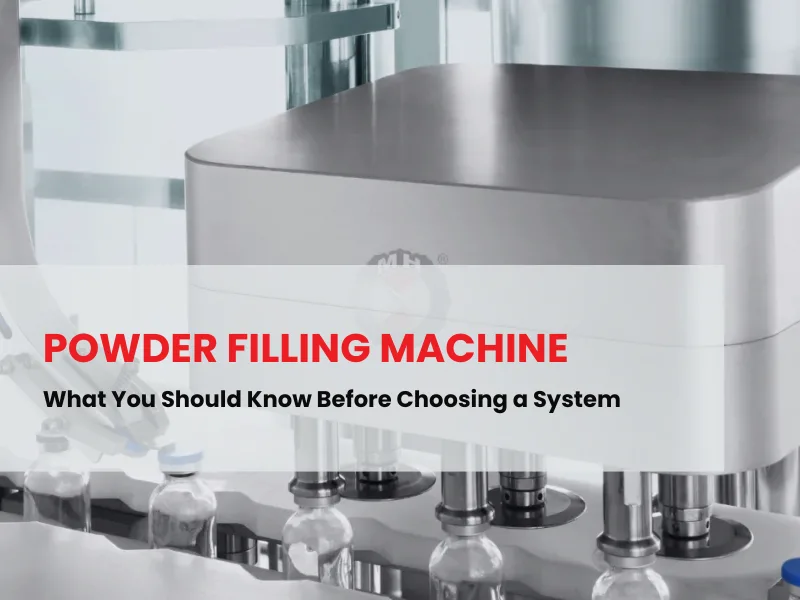
Powder Filling Machine: What You Should Know Before Choosing a System
Selecting a powder filling machine is an important step for pharmaceutical, nutraceutical, food supplement, or chemical manufacturers. The right system ensures precise dosing, reduces product loss, maintains hygiene, and meets regulatory compliance. Making the wrong choice can lead to downtime, rejected batches, or costly compliance issues.
This guide helps you understand the technical considerations, regulatory requirements, and operational factors so you can choose the system that fits your production workflow.
Understand Your Powder Characteristics
Before evaluating equipment, you must understand the behaviour of your powder. The success of your filling operation depends on powder properties such as:
- Flowability: Free-flowing, semi-free-flowing, or cohesive
- Particle size distribution
- Moisture sensitivity
- Density variations
- Static charge or dust tendency
Why this matters:
- Free-flowing powders work well with standard auger fillers.
- Cohesive or moisture-sensitive powders may need micro-auger systems or inert gas purging.
- Highly dusty powders require closed, hygienic dosing systems to protect operators and maintain product integrity.
If you produce sterile injectable powders, requirements are stricter and may involve RABS (Restricted Access Barrier Systems) or isolators.
Choose the Right Filling Technology for Your Application
Powder filling systems vary widely depending on throughput, accuracy, and regulatory requirements.
Auger Filling System
- Rotating screw dispenses powder
- Best for oral powders, injectable powders, semi-free-flowing or cohesive materials
- Advantages: High accuracy, versatile, integrates with checkweighers, medium-to-high speed
- Considerations: Requires routine calibration; dust control needed for fine powders
Vacuum/Pressure Filling
- Uses air pressure to move powders
- Best for ultra-fine, dusty, or lightweight powders
- Advantages: Minimizes dust, reduces operator exposure, maintains uniformity
- Considerations: Slower than volumetric, complex maintenance, risk of bridging if powder clumps
Net Weight Filling
- Weighs each container to exact target
- Best for high-value powders, low-to-medium batch sizes, tight fill tolerance
- Advantages: Extremely precise, compensates for density variations, reduces waste
- Considerations: Slower for high-speed lines, higher initial cost, requires calibrated load cells
Micro-Auger System
- Small servo-driven augers for mg-level fills
- Best for sterile injectable powders, clinical trial batches, R&D formulations
- Advantages: High repeatability at low volumes, suitable for isolators, minimal product loss
- Considerations: Limited throughput, higher cost, cleanroom-compatible design required
How You Should Evaluate
- Throughput: Number of containers per hour
- Target fill weight: Milligrams, grams, or larger
- Powder properties: Free-flowing, cohesive, dusty, moisture-sensitive
- Cleanability & Maintenance: Ease of dismantling, cleaning, validation
- Automation & Integration: Capping, labelling, vision inspection, data logging
- Compliance: GMP, ISO, FDA 21 CFR Part 11
- Future Flexibility: Ability to handle multiple container types or higher throughput
Tip: Sterile powders often require micro-auger systems within isolators or RABS, whereas non-sterile oral powders can often use standard auger fillers with dust containment.
Hygiene, Containment, and Sterility Requirements
Aseptic Powder Filling (Sterile Injectables)
- Required for injectable powders
- Uses isolators or RABS to maintain ISO 5 conditions
- Stainless steel GMP-grade contact surfaces
- CIP/SIP capable with HEPA-filtered airflow
MH Multipack Solution: 주사용 분말 투여 시스템
Closed-Hygiene Systems for Oral Powders
- Dust-free, anti-static design
- Easy dismantling for cleaning
- Food/Pharma-grade contact parts
- Suitable for vitamins, nutraceuticals, and non-sterile APIs
Closed-Hygiene Systems for Oral Powders
- Dust-free, anti-static design
- Easy dismantling for cleaning
- Food/Pharma-grade contact parts
- Suitable for vitamins, nutraceuticals, and non-sterile APIs
Accuracy, Repeatability, and Product Loss
Precision matters for high-value or low-dose powders:
- Fill weight deviation tolerance
- Repeatability across multiple batches
- Reject rates and waste reduction
Modern systems often feature:
- Servo-driven augers
- Micro-adjustable dosing controls
- Non-contact sensors
- Tare-in/tare-out weighing
The better the accuracy, the lower your long-term material cost.
Cleaning, Changeover, and Downtime
Efficient cleaning and rapid changeover are crucial for multi-SKU production:
- Tool-less dismantling of hopper and auger
- Smooth, crevice-free internal surfaces
- CIP/SIP compatibility
- Quick access to contact parts
This minimizes downtime, contamination risk, and validation effort.
Flexibility Across Container Formats
A versatile powder filling system should be capable of handling a wide range of container types and production requirements, including:
- Glass or plastic bottles
- Vials, jars, or RTU (ready-to-use) containers
- Single or multi-head dosing configurations
- Adjustable fill volumes for different product SKUs
For CMOs and CDMOs, flexibility is essential. Our 경구용 분말 투여 시스템 accommodates diverse container formats while maintaining consistent performance.
Automation Level and Line Integration
Automation improves efficiency and compliance:
- Semi-automatic to fully-automatic systems
- Servo-driven dosing for precision
- Auto-rejection without line stop
- Integration with capping, labelling, checkweighing, and vision inspection
- HMI/SCADA with 21 CFR Part 11 compliance
Supplier Reputation, Validation Support, and After-Sales Service
Choosing the right partner matters:
- Proven pharma equipment experience
- Local support and spare parts availability
- Validation support (DQ/IQ/OQ/PQ)
- Training and SOP guidance
- Industry references and case studies
Reliable support reduces downtime and ensures compliance.
For manufacturers seeking a trusted partner, contact our team directly to discuss your requirements, request technical specifications, or explore validation support options.
When Should You Upgrade Your Powder Filling Machine?
Consider upgrading if:
- Fill weight consistency is poor
- Powder escapes as dust
- Frequent downtime or maintenance issues
- Difficulty meeting GMP or audit requirements
- Slow throughput cannot meet demand
- Manual cleaning is time-consuming
- Lack of automation or data logging
For sterile injectable powders, consider upgrading to isolator or RABS systems.
Conclusion
Choosing the right powder filling machine is more than speed or cost. By understanding your powder, fill weight, batch size, automation, and regulatory requirements, you can select a system that maximizes accuracy, efficiency, and compliance. A carefully chosen machine will reduce product loss, improve batch consistency, and support long-term production growth.
Looking for a GMP-compliant powder filling solution?
MH Multipack provides precision powder dosing systems for oral powders, sterile injectables, and pharmaceutical production lines. Our specialists can help you select the right system based on your powder behaviour, batch size, and operational requirements.
FAQs: Powder Filling Machine – What You Should Know
What types of powders can a powder filling machine handle?
How do I choose the right filling technology for my product?
Can the machine handle multiple container types and sizes?
How do I maintain hygiene and reduce contamination risks?
What should I look for in a powder filling machine supplier?
Disclaimer:
The information provided in this article is for general informational purposes only. Readers are encouraged to consult with a qualified industry professional or contact MH Multipack for advice specific to their operations, regulatory compliance, or equipment needs. While we strive to provide accurate and up-to-date information, we cannot guarantee they are entirely error-free. MH Multipack Sdn Bhd assumes no responsibility for any errors or omissions.